
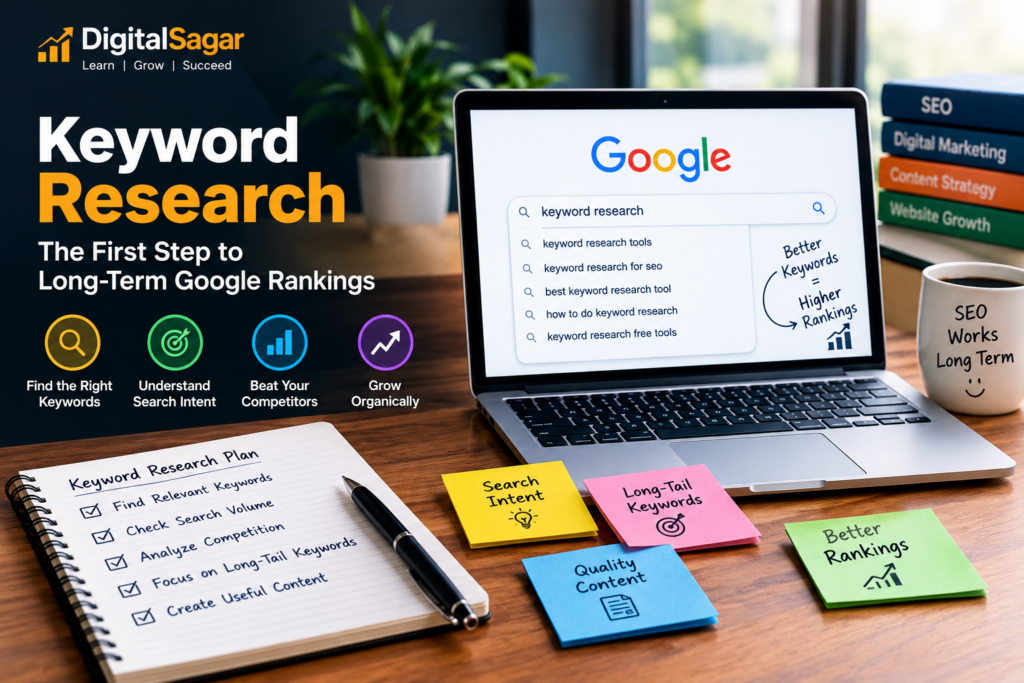
Keyword Research for Long-Term Google Rankings in 2026: A Complete Guide
Introduction
Keyword research is one of the most important parts of Search Engine Optimization (SEO). It helps you understand what people search for on Google and how to create content that matches their needs. If you want your website to rank on Google in 2026 and maintain visibility over time, choosing the right keywords is essential.
For businesses like DigitalSagar, keyword research can help attract relevant visitors who are interested in digital marketing, SEO, Google Ads, website development, and other online services.
Instead of targeting only popular keywords, a long-term SEO strategy focuses on relevant search terms, customer intent, useful content, and consistent improvement.
In this guide, you will learn how to find the right keywords, understand search intent, analyze competitors, and build a keyword strategy for sustainable website growth.
1. What Is Keyword Research in SEO?
Keyword research is the process of discovering and analyzing the words and phrases people use when searching for information, products, or services online.
For example, a business owner looking for help with website visibility might search for:
- Digital marketing services in Pehowa
- SEO services in Pehowa
- How to improve website ranking on Google
- Google Ads services for small businesses
- Best SEO practices for beginners
These searches indicate different needs. Some users want to hire a service provider, while others want to learn how SEO works.
Understanding these differences helps you create the right page or blog post for each audience.
2. Choose Keywords Based on Search Intent
Search intent means the reason behind a user’s search. Understanding it helps you create content that answers the user’s actual question.
Informational Keywords
People use these keywords when they want to learn something.
Examples:
- What is SEO?
- How does keyword research work?
- How to improve Google rankings in 2026
Content idea: Publish educational blogs, tutorials, and beginner-friendly guides.
Commercial Investigation Keywords
People use these searches when comparing services or exploring their options.
Examples:
- Best digital marketing agency in Pehowa
- SEO services comparison
- Digital marketing agency pricing
Content idea: Create service comparisons, detailed service pages, and guides that explain what customers should consider.
Transactional Keywords
These searches often indicate that someone is ready to contact or purchase from a provider.
Examples:
- Hire an SEO expert in Pehowa
- Digital marketing services in Pehowa
- Website development services in Pehowa
Content idea: Create focused service pages with clear descriptions, genuine work examples, and contact information.
3. Find Relevant Keywords Using Free SEO Tools
You do not need expensive software to start keyword research. Several free tools can help you understand search demand and identify useful content opportunities.
Google Search Suggestions
Start typing a topic into Google and review the suggested searches. These can reveal related phrases people may use.
Google Search Console
If your website already receives search impressions, Search Console can show queries that lead users to your pages. Look for relevant queries where your pages receive impressions but could better answer the searcher’s needs.
Google Keyword Planner
Keyword Planner can help you discover keyword ideas and estimated search volume. Some metrics depend on your account and advertising setup.
Google Trends
Google Trends helps compare interest in search topics over time and identify seasonal patterns.
Competitor Research
Review relevant competitors’ service pages and blog topics. Look for questions they answer that your website does not yet cover. Use this research to identify opportunities for more helpful, original content rather than copying their work.
4. Focus on Long-Tail Keywords for Better Targeting
Long-tail keywords are more specific search phrases. They often have lower search demand than broad terms, but they can attract visitors with clearer needs.
For example:
- Broad keyword: SEO
- More specific keyword: SEO services in Pehowa
- Long-tail keyword: How can a small business in Pehowa improve its Google ranking?
Long-tail keywords are especially useful for new websites because they allow you to create focused content for a particular audience or question.
However, lower competition and higher conversion rates are not guaranteed. Evaluate each phrase based on relevance, search intent, and available evidence.
5. Build a Keyword Strategy for DigitalSagar
For DigitalSagar, organize keywords into topic groups that match the services and information your website provides.
SEO and Website Ranking
- How to improve website ranking on Google
- On-page SEO techniques
- Technical SEO checklist
- How to fix common SEO mistakes
Local Digital Marketing
- Digital marketing services in Pehowa
- Local SEO for small businesses
- How to promote a business online in Pehowa
Google Ads
- Google Ads for beginners
- How to generate leads using Google Ads
- Google Ads services in Pehowa
Website Development
- Website development services in Pehowa
- Why small businesses need a website
- How to make a website mobile-friendly
Each keyword group can support a main service page and related educational blog posts. Link these pages together where it helps visitors discover relevant information.
6. Analyze Keyword Difficulty and Competition
Before choosing a keyword, consider how difficult it may be to compete for it.
Review the pages currently ranking for your target query. Consider:
- Are the results local service pages, guides, product pages, or videos?
- Do the existing pages answer the searcher’s question well?
- Is your website capable of providing a more useful answer?
- Does your business genuinely serve the target location?
- Can you create original information or practical examples?
SEO tools such as Ahrefs and Semrush provide keyword difficulty estimates, but these are third-party metrics rather than official Google ranking scores.
Do not choose a keyword based only on a difficulty number. Relevance and your ability to satisfy the search intent are equally important.
7. Create Helpful Content Around Your Keywords
After selecting keywords, create content that answers the reader’s question clearly and thoroughly.
A useful SEO blog should include:
- A descriptive title
- A clear introduction
- Relevant headings and subheadings
- Practical steps and examples
- Natural keyword usage
- Relevant internal links
- Useful images with descriptive alt text
- A clear conclusion and appropriate call to action
Avoid repeating the same keyword unnaturally or creating several nearly identical pages targeting the same search intent.
Your priority should be helping readers, not writing for a keyword density target.
8. Use Internal Linking to Build Topic Authority
Internal links connect related pages on your website. They help visitors navigate your content and help search engines discover relationships between pages.
For example, a blog about keyword research can link naturally to:
- Your SEO services page
- Your guide to improving Google rankings
- Your local SEO guide
- Your website development services page
Use descriptive anchor text so readers understand what they will find after clicking. Only link to pages that are genuinely relevant.
9. Track Keyword Performance and Update Your Strategy
Keyword research is not a one-time task. Search behavior, competition, and your website’s performance can change over time.
Use Google Search Console to monitor:
- Queries generating impressions and clicks
- Pages gaining or losing search visibility
- Click-through rates for important queries
- Search terms that reveal new content opportunities
- Indexing problems affecting key pages
Update your content when the information becomes outdated, when search intent changes, or when performance data reveals a clear opportunity to improve the page.
Avoid making unnecessary changes simply because a page’s ranking moves for a short period.
10. Common Keyword Research Mistakes to Avoid
Some common mistakes can weaken your SEO strategy:
- Targeting keywords that are unrelated to your services.
- Choosing keywords only because they have high search volume.
- Ignoring the user’s search intent.
- Copying competitors instead of creating original content.
- Repeating keywords excessively.
- Publishing multiple pages with substantially overlapping purposes.
- Ignoring local relevance when targeting Pehowa customers.
- Expecting immediate rankings from newly published content.
A long-term strategy requires useful content, technical reliability, relevant links, and regular performance reviews.
11. A Simple 90-Day Keyword Research Plan
Days 1–30: Research and Planning
- List your main services and target audiences.
- Research relevant keywords using free tools.
- Group keywords by search intent.
- Review existing pages and identify missing topics.
Days 31–60: Content Creation
- Improve important service pages.
- Publish useful blogs around selected keyword groups.
- Add relevant internal links.
- Make sure pages work well on mobile devices.
Days 61–90: Measurement and Improvement
- Review Google Search Console data.
- Identify pages receiving impressions but few clicks.
- Improve content where it does not fully satisfy search intent.
- Plan future articles based on genuine content gaps.
This is a practical planning framework, not a guarantee of rankings within 90 days.
Conclusion
Keyword research is the foundation of a sustainable SEO strategy. By understanding search intent, choosing relevant long-tail keywords, studying competitors, and creating helpful content, businesses can build a stronger foundation for long-term Google visibility.
For DigitalSagar, combining SEO education with relevant service pages for digital marketing, Google Ads, website development, and local SEO can help attract the right audience.
Focus on solving real customer problems, measuring results, and improving your content consistently rather than chasing quick ranking tricks.
Want to improve your website’s SEO strategy?
Visit https://digitalsagar01.com/ to explore DigitalSagar’s digital marketing resources and services.